
The Allocators' Table: Climate Strategy Dialogues for LPs
🌐 Language: English
♿ Wheel-chair accessible
💶 Event free of charge
🎟️ Hosted by: Tech for Impact Summit
An invitation-only afternoon for allocators: two fireside chats, two panels, one round of standing roundtables under the Chatham House Rule, then drinks and food.
Tuesday 20 October 2026, 15:00 to 19:00, Munich. Held during Munich Climate Week (19 to 25 October 2026).
Why this afternoon
At Tech for Climate at Oktoberfest in September, one table was kept for allocators only. Its question was simple: how do you go from caring about climate to putting money behind it?
This afternoon picks up where that table stopped, with the questions allocators are actually asking in October 2026. Defence, AI and power have taken the money climate funds raised in 2021. Who in this room has moved, who has stayed, and what do they now ask of a fund? Where does the money come back from? Should a foundation put its endowment, not just its grants, behind its mission? And what do Japanese and Korean corporates need before they commit to a European fund or buy from a European plant?
Seira Yun, the host, works between Europe and Asia. So Japan and Korea come up on stage and at the tables: corporate LPs from both regions, cross-border fund allocation, and who buys the output of a European plant.
The format
Two short conversations on stage, two panels, and one round of thirty-minute standing roundtables, each on one question. Then the room stays together over drinks and food.
Fireside chat: two people, twenty-five minutes, one question. No slides.
Panel: four people and a moderator, forty minutes. Half the time belongs to the room.
Standing roundtable: six tables of about eight people, thirty minutes. A table lead opens with two minutes, then the table talks. The Chatham House Rule applies: use what you hear, never who said it.
Drinks and food from 18:00. This is where the real matching happens.
There are no sponsors, no pitches and nothing for sale. Attendance, drinks and food are free of charge.
Run of show
14:45 Doors open
15:00 Welcome
15:10 Fireside chat I: Where did the climate money go?
15:35 Panel I: Who pays for the grid
16:15 Break
16:25 Fireside chat II: Putting the endowment to work
16:50 Panel II: Real DPI in climate venture
17:30 Standing roundtables, one round
18:00 Drinks and food
19:00 Close
The sessions
Fireside chat I: Where did the climate money go? Climate-specialist funds raised a fraction of what they did in 2021. Defence, AI and power raised the rest. Two allocators who made opposite calls: a single family office that moved its venture book to defence and deep tech and says so openly, and an investor who kept allocating to climate and now asks harder questions. Is "climate" still a line in the allocation, or a lens over infrastructure, energy and industrials?
Panel I: Who pays for the grid. Data centres, heat pumps and electric fleets all wait on the grid, and a connection can take years. Firm power, from storage to nuclear and fusion, had a record year. Where does an allocator in this room get exposure: an infrastructure fund, grid-technology venture, a corporate's own balance sheet? Who carries the merchant and permitting risk? And is this a climate case or a returns case, and does the difference matter to you?
Fireside chat II: Putting the endowment to work. One foundation has put its entire endowment behind its mission. Another holds climate venture funds inside a conventional endowment. What did the trustees have to accept, what did it cost in return and liquidity, and what would each do again? For the foundations in the room, this is the question before catalytic capital: whose money is it, and how much of it is allowed to work?
Panel II: Real DPI in climate venture. Four allocators who have backed many funds on liquidity in a ten-year asset class. Distributions against paper marks. Secondaries and continuation vehicles after a record half-year. Evergreen and SPV structures. What a climate hardware fund now has to offer before a family office signs.
The standing roundtables
Each table takes one question. A table lead opens it in two minutes, then eight people talk it through, standing. When you register, please name your table.
Table 1: Japanese and Korean capital for European plants. Japan's emissions trading is starting to bite, and Japanese and Korean corporates are LPs, offtakers and buyers of European climate companies. What do they need to see before committing, and what does a European fund or plant have to change?
Table 2: Do we still say impact? In Germany the word reads as charity, cleantech reads as politics, and SFDR 2.0 will relabel every fund. What do you call this book internally, and what does the label change about who approves it?
Table 3: Co-investing with public guarantees. Germany's new infrastructure and climate fund, KfW and EIF anchors, public guarantees. Where can a private allocator sit alongside, and where does public money crowd you out or lock you in?
Table 4: Does defence belong in the sustainability bucket? Grid security, energy independence, critical materials. Defence is Europe's fastest-growing venture segment and it is taking allocations that used to go to climate. Which mandates allow it, which exclude it, and who in your house decides?
Table 5: Revenue models for physical climate risk. Floods, heat, water and crop risk. What turns adaptation into revenue an investor can underwrite, and where does catalytic capital belong in the stack?
Table 6: Investing the foundation corpus. For foundation investors who have decided to move the endowment, not only the grants: mandate, trustees, German foundation law, the first fund and the reporting that follows. A peer exchange, not a primer.
Who should be in the room
Every seat is held by an allocator: family offices, private investors, foundations, fund-of-funds, institutional investors, and corporate LPs, meaning corporates that commit to venture and climate funds as limited partners. Every speaker is an allocator too; nobody on stage is raising a fund or pitching a company.
Participation is by invitation. If a colleague belongs in the room, please tell us, subject to the seats available. The venue is shared with confirmed guests.
Hosts
The Tech for Impact Summit (T4IS) is an invitation-only summit held every year in Tokyo, with smaller gatherings like this one in between.
Your host: Seira Yun. Founder and CEO of Socious, convener of the Tech for Impact Summit, and host of Tech for Climate at Oktoberfest. Works between Europe and Asia.
Hosting this event?
Ready-made share images with the date, venue and the Munich Climate Week mark — post them as they are.
Future Skill of The Day - 30min Daily Practice
08:30 AM – 09:00 AM
Change Corporation
Aller Anfang ist YEAH - EmpCo Edition
09:00 AM – 01:00 PM
Zentralsüden GmbH x B.A.U.M. Consult
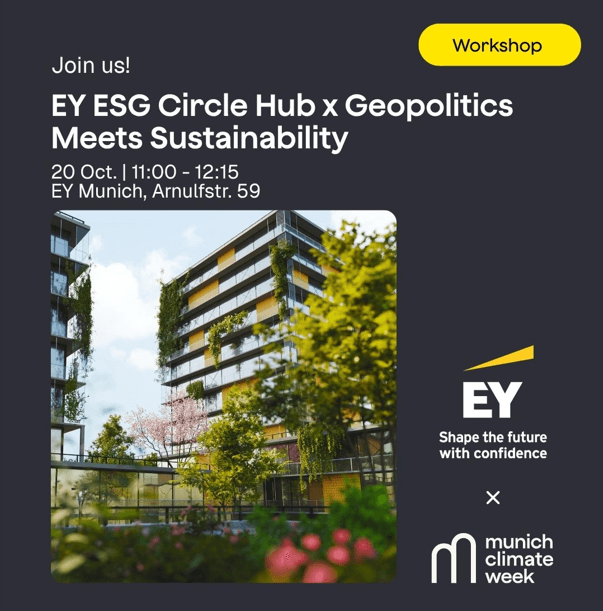
ESG Circle Hub EY x WWF: Geopolitics Meets Sustainability - New Rules for Resilient Corporate Management
09:00 AM – 10:45 AM
EY